
How Rosehill TPV binders work: Why the binder choice matters as much as the granule
Posted on October 2026 || Last Updated on October 2026 || Author: Yash
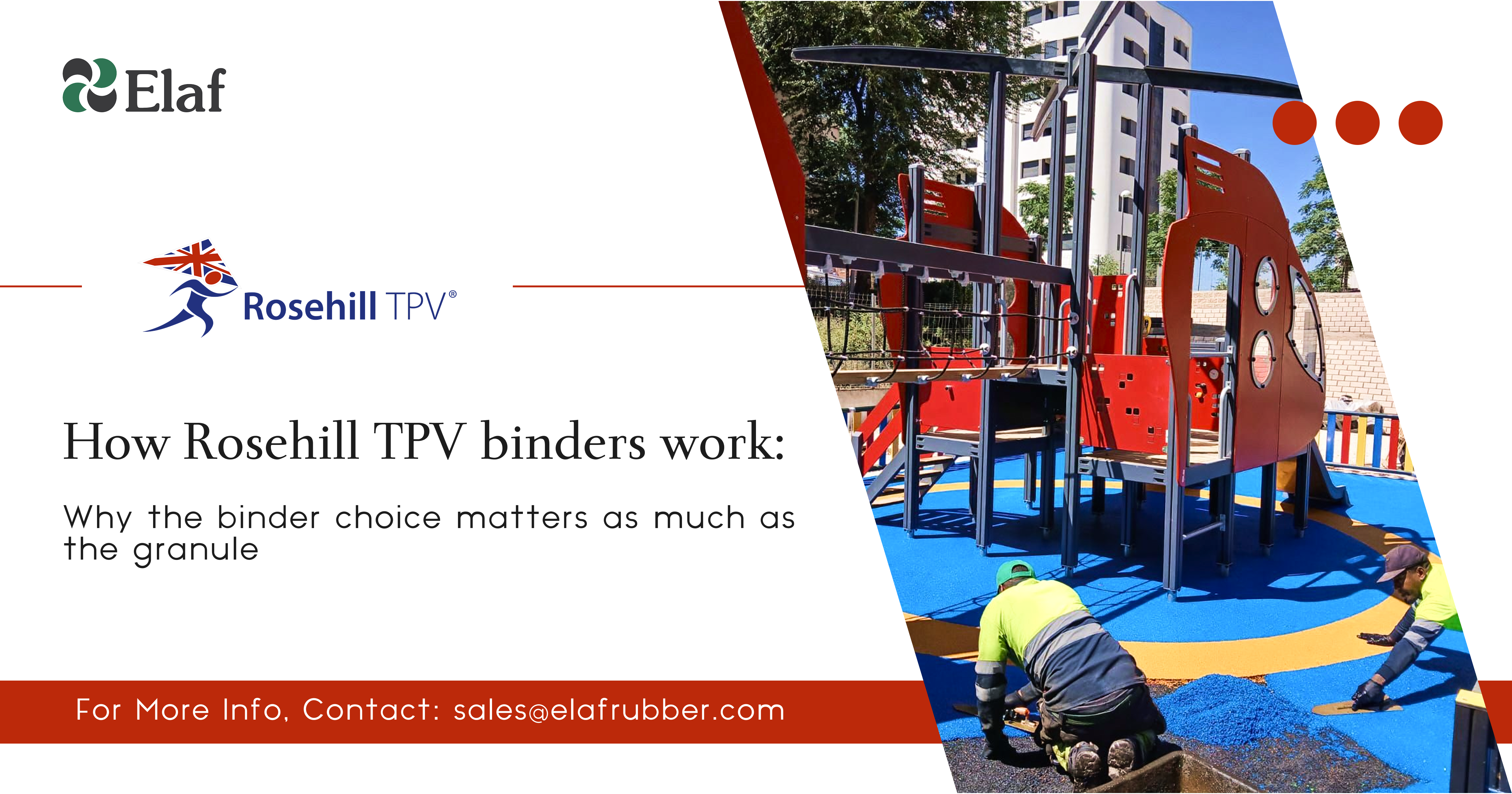
When a wet-pour rubber surface fails, the conversation usually starts with the granule. The wrong colour, the wrong compound, the wrong supplier. But in a significant number of premature surface failures, the granule performed exactly as specified. The binder did not.
The binder is the adhesive system that holds a wet-pour surface together, bonding granule to granule, layer to layer, and the whole system to the substrate beneath. In the UAE, Saudi Arabia and wider GCC, where UV intensity, sustained heat and extreme thermal cycling place exceptional stress on outdoor surfaces, the binder chemistry is not a secondary specification. It is a primary one. This article explains how the Rosehill TPV Flexilon binder system works, what MDI chemistry means in practice, and why specifiers across the UAE and Saudi Arabia should be asking about the binder as closely as they ask about the granule.
What a Binder Actually Does
In a wet-pour rubber surface, the binder is the polyurethane adhesive mixed with the granule to create a workable compound that cures into a continuous, bound surface layer.
Its job is structural: it holds the granule matrix together under foot traffic, impact, thermal expansion and contraction, and exposure to UV and moisture. A binder that breaks down under these stresses does not just become less adhesive, it causes the granule to separate, the surface to crack, and the system's fall protection and slip resistance properties to degrade progressively from the point of failure.
The granule determines the surface's aesthetic and base performance properties. The binder determines whether those properties hold up over the life of the installation.
MDI vs TDI: The Chemistry That Matters for Hot Climates
Not all polyurethane binders are chemically equivalent. The two main isocyanate types used in wet-pour binders are MDI (methylene diphenyl diisocyanate) and TDI (toluene diisocyanate), and the difference between them has direct consequences for surface performance in extreme climates.
TDI-based binders are more volatile during application and have known yellowing tendencies when exposed to UV radiation. In sustained high-UV environments like the Gulf, this yellowing effect is accelerated, and it is not only aesthetic. UV degradation of the binder matrix weakens the bond between granules over time.
MDI-based binders are less volatile, carry lower toxicity risk during installation, and perform more consistently under UV exposure. For outdoor surfacing in the UAE and Saudi Arabia, where a surface may be exposed to intense solar radiation year-round, MDI chemistry is the correct specification baseline.
Every Flexilon binder in the Rosehill range is MDI-based and TDI-free. Rosehill Polymers Ltd has been developing MDI polyurethane binders for sports, play and industrial applications since 1989. That is not a recent product claim, it is over three decades of MDI-specific development for exactly these environments. The full Flexilon binder range is available with technical data sheets for each variant.
Why Cure Rate Is a Specification Decision, Not an Installer Preference
One aspect of binder selection that most specifiers leave to the contractor is cure rate. This is a mistake.
Cure rate determines how long the binder takes to set from application to a workable surface. In a hot climate, a fast-curing binder can begin to skin before the installer has finished spreading and compacting the mix, compromising the bond at the granule surface and creating weak points in the cured layer. A slow-curing binder in a cool climate, conversely, may take too long to cure, risking moisture contamination before the system has set.
The Flexilon range addresses this directly through climate-matched variants. For warm climates typical of the UAE and GCC, the slow-to-medium curing formulations are the correct specification:
• Flexilon FX 457 — Medium curing for warm climates, low-viscosity, solvent-free
• Flexilon FX 1102 — Slow curing for warm climates or where long open time is needed
• Flexilon FX 1230 — Very slow curing for warm climates or extended open time
• Flexilon FX 1248S / FX 1248W —Very slow and slow curing respectively for warm conditions and long working time
• Flexilon FX 1258 — Very slow curing for warm climates and long open time
Selecting the right cure rate for the ambient temperature at installation is not a site-day decision. It belongs in the specification before the contractor arrives.
UV Stability in the Binder
Granule UV stability is well understood for Rosehill TPV, it is a core property of the compound. Less commonly discussed is UV stability in the binder itself.
Binder yellowing is the surface discoloration that occurs when polyurethane systems are exposed to sustained UV without adequate stabilisation. On a coloured playground surface, binder yellowing changes the appearance of the finished surface independently of the granule colour, effectively adding a yellow or amber cast to the overall tone over time.
Rosehill addresses this directly within the Flexilon range. Flexilon FX 1231 is formulated specifically for improved UV stability, offering reduced early discoloration for surfaces installed in warm climates with high UV exposure. Combined with the inherent UV resistance of the TPV granule, this creates a system where both the granule and the binder resist the primary failure mode of outdoor surfaces in the Gulf.
A surface's colour retention is only as good as the least UV-stable component in the system. Specifying UV-stable granules alongside a binder not formulated for UV exposure is an incomplete solution.
Solvent-Free Formulation
Every Flexilon binder in the range designated for granule bonding is solvent-free. This matters for two reasons.
First, solvent-based binders carry VOC (volatile organic compound) emissions during application and initial cure. For playground installations where children will use the space shortly after completion, a common situation in school and nursery projects across the UAE and Saudi Arabia, solvent-free formulations reduce the chemical exposure risk during that window.
Second, solvent content can affect the long-term elasticity of the cured binder matrix. Solvent-free systems tend to maintain their flexibility more consistently over the life of the surface, which is relevant for surfaces in thermal cycling environments where the bound granule layer must expand and contract without cracking the binder.
Conclusion
The binder is half the system. Specifiers who treat it as a commodity purchase; whatever the contractor supplies, whatever is cheapest, are making a decision that affects the surface's safety performance, appearance and lifespan from day one, often without realising it.
The Rosehill Flexilon range was developed specifically to give specifiers and installers a technically matched system: MDI-based, TDI-free, solvent-free, with climate-appropriate cure rates and UV-stable options for exactly the conditions found across the UAE, Saudi Arabia and wider GCC.
Get in touch with the Elaf Rubber team to specify the right Rosehill TPV granule and Flexilon binder combination for your project. We can provide full technical documentation for both components and advise on the correct cure rate for your installation conditions.
FAQs
1. Why does binder choice matter for playground surfacing in the UAE?
In the UAE's extreme climate, the binder in a wet-pour surface is exposed to the same UV radiation, sustained heat and thermal cycling as the granule, and if the binder chemistry is not matched to these conditions, the surface will fail from the bond outward regardless of granule quality. For playground and sports surfacing projects across Dubai, Abu Dhabi and the wider UAE, specifying an MDI-based, TDI-free, solvent-free binder with a cure rate matched to warm climate conditions is as important as the granule specification. The Rosehill Flexilon range offers climate-specific variants developed for exactly these environments.
2. Which Flexilon binder is right for outdoor surfacing projects in Saudi Arabia?
For playground, track and public-space surfacing projects across Saudi Arabia, including Riyadh, Jeddah and Dammam, slow-to-medium curing Flexilon variants are the correct specification. Saudi Arabia's summer temperatures are among the most extreme in the world, which means fast-curing binders can skin prematurely before the mix is fully compacted, weakening the granule bond. Flexilon FX 1102, FX 1230 and FX 1248S are specifically formulated for hot and warm climates with extended open time.
3. What is the difference between MDI and TDI binders for rubber surfacing in the GCC?
MDI (methylene diphenyl diisocyanate) binders perform more consistently under UV and heat than TDI (toluene diisocyanate) alternatives, making them the correct specification for outdoor surfacing across the GCC. TDI-based binders are more volatile during application and have a known tendency to yellow under sustained UV exposure, which in the Gulf's high-solar environment accelerates both aesthetic degradation and structural weakening of the binder matrix. All Flexilon binders supplied through Elaf Rubber for UAE, Saudi Arabia and wider GCC projects are MDI-based and TDI-free.